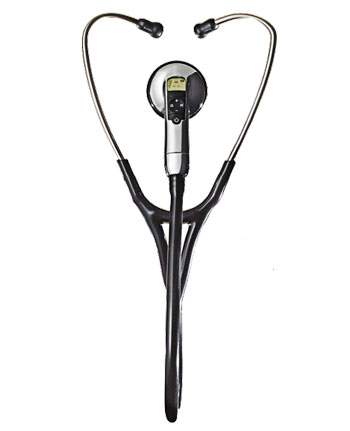
 The stethoscope hasn’t undergone many significant breakthroughs until now. 3M’s new stethoscope listens to a patient’s heartbeat, captures the sound for later playback, lets you transmit sounds real-time to your PC, which can then be further analyzed, attached to medical records, or reviewed online with colleagues.
Saturday, January 29, 2011
Electronic Stethoscope
The stethoscope hasn’t undergone many significant breakthroughs until now. 3M’s new stethoscope listens to a patient’s heartbeat, captures the sound for later playback, lets you transmit sounds real-time to your PC, which can then be further analyzed, attached to medical records, or reviewed online with colleagues.
Saturday, January 22, 2011
TESLA'S POWER TOWERS
To gather in the latent electricity in the clouds and with the globe itself as a medium of transmission to convey telegraphic messages, power for commercial purposes, or even the sound of the human voice to the utmost confines of the earth is the latest dream of Nikola Tesla.
In an article which appeared recently in The Electrical World Mr. Tesla explains the theories on which the world telegraphy system is founded and what he expects to accomplish by it. His plans involve the establishment of stations for the transmission of messages and power, "preferably near important centers of civilization." Oddly enough, what Mr. Tesla proudly designates as the first of his commercial "world telegraphy" stations has been established at Wardenclyffe, L.I., which is not in any sense an important "center of civilization," but a place described by train hands of the Long Island Railroad as a way station where "a passenger alights occasionally."
The transmitting station is an octagonal tower, pyramidal in shape, and some 180 feet in height. It consists of huge wooden stilts, heavily braced, and reinforced, and surmounted by a cupola of interlaced steel wires, bent so as to form an arc. In the cupola there is a wooden platform occupying its entire width.
Mr. Tesla began work on his transmitting station about eighteen months ago. When he first came there, and it was understood that J. Pierpont Morgan had become interested in his odd enterprise and furnished him with financial assistance, a thrill of vague expectancy ran through the little settlement, The Wardenclyffe Land Company, which owns practically all the available ground in the vicinity, gave the inventor a free grant of some 175 acres of fine land, and then settled down to wait for the day when Wardenclyffe would become the center of the universe.
Some of the farmers who come to Wardenclyffe to send their products to this city look at Mr. Tesla's tower, which is situated directly opposite the railroad station, and shake their heads sadly. They are inclined to take a skeptical view regarding the feasibility of the wireless "world telegraphy" idea, but yet Tesla's transmitting tower as it stands in lonely grandeur and boldly silhouetted against the sky on a wide clearing on the concession is a source or great satisfaction and of some mystification to them all. "It is a mighty fine tower," said one food farmer to a visitor last week. "The breeze up there is something grand of a Summer evening, and you can see the Sound and all the steamers that go by. We are tired, though, trying to figure out why he put it here instead of at Coney Island." While the tower itself is very "stagey" and picturesque, it is the wonders that are supposed to be hidden in the earth underneath it that excite the curiosity of the population in the little settlement. In the center of the wide concrete platform which serves as a base for the structure there is a wooden affair very much like the companionway on an ocean steamer. The tower and the enclosure in which it has been built are being carefully guarded these days, and no one except Mr. Tesla's own men is allowed to approach it. Only they have been allowed as much as the briefest peep down the companionway. Mr. Scherff, the private secretary of the inventor, told an inquirer that the companionway led to a small drainage passage built for the purpose of keeping the ground about the tower dry. But such of the villagers as saw the tower constructed tell a different story. They declare that it leads to a well-like excavation as deep as the tower is high with walls of masonwork and a circular stairway leading to the bottom. From there, they say, tunnels have been built in all directions, until the entire ground below the little plain on which the tower is raised has been honeycombed with subterranean passages. They tell with awe how Mr. Tesla, on his weekly visits to Wardenclyffe, spends as much time in the underground passages as he does on the tower or in the handsome laboratory and workshop erected beside it, and where the power plant for the world telegraph has been installed.
No instruments have been installed as yet in the transmitter, nor has Mr. Tesla vouchsafed any description of what they will be like. But in his article he announces that he will transmit from the tower an electric wave of a total maximum activity of ten million horse power. This, he says, will be possible with a plant of but 100 horse power, by the use of a magnifying transmitter of his own invention and certain artifices which he promises to make known in due course. What he expects to accomplish is summed up in the closing paragraph as follows:
"When the great truth, accidentally revealed and experimentally confirmed, is fully recognized, that this planet, with all its appalling immensity, is to electric currents virtually no more than a small metal ball and that by virtue of this fact many possibilities, each baffling imagination and of incalculable consequence, are rendered absolutely sure of accomplishment; when the first plant is inaugurated and it is shown that a telegraphic message, almost as secret and non-interferable as a thought, can be transmitted to any terrestrial distance, the sound of the human voice, with all its intonations and inflections faithfully and instantly reproduced at any other point of the globe, the energy of a waterfall made available for supplying light, heat or motive power, anywhere--on sea, or land, or high in the air--humanity will be like an antheap stirred up with a stick. See the excitement coming!"
The mother of all inventions
The mother of all inventions

The Science Museum, favourite haunt of aspiring astronauts and eccentric professors, celebrates its centenary this month. To mark the occasion, it is today launching a public vote to choose the most important scientific invention of the past few centuries. Curators have selected 10 objects which they believe to be most significant in the history of science, engineering, technology and medicine and are inviting the public to decide the winner. Voting will take place over the summer for the innovation which they believe has had (or will have) the greatest impact on the past, present or future.
The iconic objects are being organised into a Centenary Journey trail, which will open at the museum later this month. The winning object will be announced in October.
Tim Boon, chief curator of the museum, admitted the idea of scientific “progress” was controversial. “Some of the objects may divide opinion. Would we be better off if some of the “icons”, which have had negative consequences, had not been invented? We are looking forward to a great debate.Some of the museum’s supporters have already made their choice. Trevor Baylis, inventor of the clockwork radio, is voting for the V2 rocket engine: “It’s one of the greatest achievements of our time because it led to space exploration, and then satellite development, which then led to mobile phones and the astounding communication services we enjoy today.”
Musician Nitin Sawhney chooses penicillin: “As an asthmatic recovering from a debilitating bout of pneumonia, I am painfully aware of how important a role penicillin has played in curing my lung infection. In this regard I’m hardly alone.”
Television presenter and biologist Alice Roberts’s vote is going elsewhere:
“As a doctor and anatomist, I’m championing the X-ray machine. X-rays provided the first possibility of looking inside someone’s body without cutting them open.”
Television presenter James May votes for the Apollo 10, “as it represents the furthest reach to date of manned exploration.” Broadcaster Adam Hart-Davis believes the steam engine to be “the most important step forward in technology of all time.”
KNUST freshmen can manufacture helicopters
KNUST freshmen can manufacture helicopters
The Vice Chancellor of the Kwame Nkrumah University of Science and Technology (KNUST), Prof Kwesi Andam, has taken a swipe at the technological inventions of the leader of the Kristo Asafo Mission, Apostle Dr Kwadwo Safo, describing them as “nonsensical”. 
He said the nation’s priority should be to use science and technology to advance development and not the manufacturing of helicopters and machines to produce cement blocks.
Prof Andam said this in apparent reference to the latest technological claims by Apostle Safo that he has manufactured helicopter, television and roofing tiles mahine among others.
According to Prof Andam, even freshmen of the KNUST could manufacture helicopters within some few months but said that was not the priority of the university.
“The university should be allowed to do what it is supposed to do and not the kind of nonsensical things going on”, he said.
Prof Andam was responding to a comment by a participant after delivering a lecture on the topic; “Science and Technology for National Development”, at the 57th Annual New Year School at the University of Ghana, Legon, yesterday.
A participant suggested that the authorities at the KNUST should liaise with Apostle Dr Safo to tap into his expertise and, if possible, invite him to give lectures at the university.
A participant suggested that the authorities at the KNUST should liaise with Apostle Dr Safo to tap into his expertise and, if possible, invite him to give lectures at the university.
Prof Andam reacted angrily to that suggestion and appeared emotional at certain stages as he used the words “nonsense” and “nonsensical” in a stern voice in reference to Apostle Dr Safo’s claims.
There were mixed reactions to the ViceChancellor’s response. While some people applauded him, others expressed disapproval, especially at his use of the words “nonsense” and “nonsensical”.
Apostle Safo has gained popularity for his technological inventions. In recognition of that the University of Ghana awarded him an honorary doctorate degree, while the University of Education, Winneba, has offered to document all his inventions.
Recently, there has been some media exchanges between Apostle Dr Safo and the authorities of KNUST. The Apostle was reported to have criticised some graduates of the university who worked with him for not being able to cope with the practical aspect of his technologal works but the university authorities reacted to the Apostle’s criticism, describing it as false.
Prof Andam said it was important for the nation to understand that KNUST was established to train a core of highly skilled technical professionals who would work in key sectors to advance the development of the nation.
He said about 95 per cent of engineers at the Volta River Authority (VRA), as well as majority of the engineers at the Ghana Water Company Limited (GWCL) and the Volta Aluminium Company (VALCO), were all products of KNUST and wondered what would happen to the nation if the Akosombo Dam, for instance, was shut for a few days.
Prof Andam said there was no need to engage in a debate over the inventions of Apostle Dr Safo and the capabilities of graduates from the university, adding that the priority of the university was not re-engineering but engineering.
Moving away from Apostle Safo’s inventions, the KNUST ViceChancellor announced that the university would introduce distance education programmes in Mathematics, Building Technology and Computer Engineering, next academic year.
He noted that distance education in science and technology programmes was very expensive and so there was the need to establish laboratories and other facilities for such purposes.
Delivering the main lecture, Prof Andam underlined the need for the nation to invest more in science and technology education, which, he said, was the key to development.
He said there was also the need to increase access to education, especially at the higher level, since there was a corrrlation between education and wealth creation.
The Chief Executive Officer of the Korle-Bu Teaching Hospital, Prof Kwabena Frimpong-Boateng, who chaired the function, said it was unfortunate that African countries spent about $40 billion annually to pay about 100,000 expatriates, although there were many Africans with the same qualification who worked abroad.
“Many years ago, the Chinese built the Great Wall of China without any help from the World Bank. But we can’t build a drainage without World Bank support”, he remarked.
Prof Frimpong-Boateng said development projects were not the construction of roads but projects that would ensure less dependence on foreign capital and influence.
He said he was startled by statistics on the dropout rate, particularly at the basic education level, pointing out that, “We are at the point of doom. We are committing suicide”
There were mixed reactions to the ViceChancellor’s response. While some people applauded him, others expressed disapproval, especially at his use of the words “nonsense” and “nonsensical”.
Apostle Safo has gained popularity for his technological inventions. In recognition of that the University of Ghana awarded him an honorary doctorate degree, while the University of Education, Winneba, has offered to document all his inventions.
Recently, there has been some media exchanges between Apostle Dr Safo and the authorities of KNUST. The Apostle was reported to have criticised some graduates of the university who worked with him for not being able to cope with the practical aspect of his technologal works but the university authorities reacted to the Apostle’s criticism, describing it as false.
Prof Andam said it was important for the nation to understand that KNUST was established to train a core of highly skilled technical professionals who would work in key sectors to advance the development of the nation.
He said about 95 per cent of engineers at the Volta River Authority (VRA), as well as majority of the engineers at the Ghana Water Company Limited (GWCL) and the Volta Aluminium Company (VALCO), were all products of KNUST and wondered what would happen to the nation if the Akosombo Dam, for instance, was shut for a few days.
Prof Andam said there was no need to engage in a debate over the inventions of Apostle Dr Safo and the capabilities of graduates from the university, adding that the priority of the university was not re-engineering but engineering.
Moving away from Apostle Safo’s inventions, the KNUST ViceChancellor announced that the university would introduce distance education programmes in Mathematics, Building Technology and Computer Engineering, next academic year.
He noted that distance education in science and technology programmes was very expensive and so there was the need to establish laboratories and other facilities for such purposes.
Delivering the main lecture, Prof Andam underlined the need for the nation to invest more in science and technology education, which, he said, was the key to development.
He said there was also the need to increase access to education, especially at the higher level, since there was a corrrlation between education and wealth creation.
The Chief Executive Officer of the Korle-Bu Teaching Hospital, Prof Kwabena Frimpong-Boateng, who chaired the function, said it was unfortunate that African countries spent about $40 billion annually to pay about 100,000 expatriates, although there were many Africans with the same qualification who worked abroad.
“Many years ago, the Chinese built the Great Wall of China without any help from the World Bank. But we can’t build a drainage without World Bank support”, he remarked.
Prof Frimpong-Boateng said development projects were not the construction of roads but projects that would ensure less dependence on foreign capital and influence.
He said he was startled by statistics on the dropout rate, particularly at the basic education level, pointing out that, “We are at the point of doom. We are committing suicide”


Friday, January 21, 2011
The driest place in the world
The driest place in the world – Atacama Desert. Atacama desert is located in South America between Andes mountains and the Pacific Ocean in northern Chile. It is made of salt basins, lava flows and sand. It is over 20 million years old. Atacama desert is almost sterile because Andes blocked all moisture pass to Atacama. On some places in Atacama wheather station never received rain. By the evidence in Atacama there was no more important rainfall from 1570 to 1971. Even Mountains that reaches over 6500 meters are glacier free.

Some regions in Atacama gets some marine fog which is sufficient to support some algaes, lichens and cacti, but other dry parts are compared to Mars (Atacama is used for filming some Mars Scenes for movies). In 2003 in Science Magazine scientist published tests used by Viking 1 and Viking 2 Mars landers for life detection, and they were unable to detect any signs of life in Atacama soil. In the middle of desert there is oasis, at about 2000 m above sea level. Oasis is home for village San Pedro de Atacama which is very popular tourist destination. Because of high altitude, and nearly non existent clouds, lack of light polution and radio interference Atacama is one of the best places for astronomical observations. Atacama desert has world largest natural supply of Sodium Nitrate which was mined at enormous ammounts until early 1940s. Now across the desert there is more then 170 abandoned nitrate mining towns, because of invention of synthetic nitrate in Germany. Some of ghost towns are Chacabuco, Humberstone, Puelma, Santa Laura… Across the desert runs Pan American highway.


information about dinosaurs
Hello and good day to you! I’m Pterry and this is Pterry’s True Science. I’ll be stopping by the blog from time to time to share news and information about dinosaurs like me and my pals.
Today I’ve come to tell you about a scientist that is working on creating dinosaurs by manipulating genetics. Hans Larsson, the Canada Research Chair in Macro Evolution at Montreal’s McGill University wants to develop dinosaur traits that disappeared through evolution into birds.

It’s not as hard as you might think, birds are essentially dinosaurs and they have a lot of the same genes that dinosaurs did. It’s a matter of turning the right ones on to make them a dinosaur. There is a splendid video with the famous Jack Horner discussing this on the Discovery Channel video page called “The Futurist: Engineering Dinosaurs.”
Well thanks for your time, I have a new invention I’m whipping up and need to get back to!
Subscribe to:
Posts (Atom)